What Is a Men's Medium, Really? Seven UK Brands and a 7cm Question
What we did
We measured the official size charts of seven UK menswear brands — COS, H&M, ASOS, Reiss, M&S, New Look and River Island. They mostly agree on what a "medium" is. Here's why that agreement still won't make it fit.
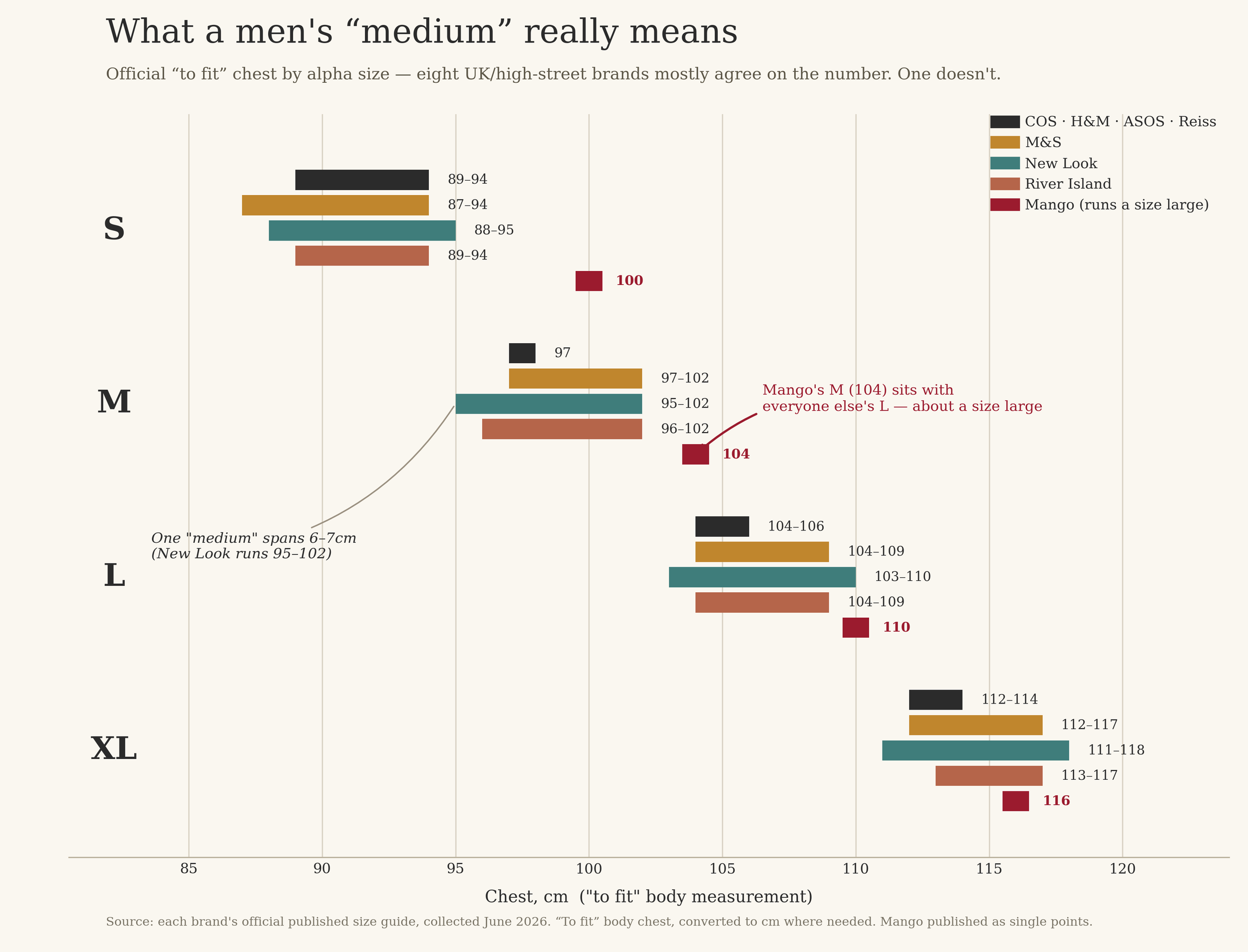
The first-pull brands publish near-single-point body figures; the British-heritage trio (M&S, New Look, River Island) publish ranges. Mango publishes single points too and runs about a size large — its M (104cm) sits with everyone else's L (104–109). Medium window across the pack: M&S 5cm, River Island 6cm, New Look 7cm.
What Is a Men's Medium, Really?
Stand in a changing room long enough and you start to believe the label. Medium. It sounds like a settled fact about your body somewhere between too little and too much, a fixed point you can trust from one shop to the next.
We wanted to know if it was true. So we did the unglamorous thing: we read the official size guides of seven UK high-street brands - COS, H&M, ASOS, Reiss, Marks & Spencer, New Look and River Island — and lined up the numbers behind the letter.
The first surprise is a quiet one. They mostly agree.
Where womenswear sizing scatters — the same waist landing two or three dress sizes apart depending on the brand — men's alpha sizing holds together. Across all seven, a medium centres on a chest of roughly 96 to 102 centimetres. No brand strays far from the pack. If you've ever assumed men's sizing was the more sensible of the two systems, the data is, briefly, on your side.
And then you look closer.
The window nobody mentions
The agreement is about where the medium sits. It says nothing about how wide it is.
At New Look, a medium is built to fit a chest of 95 to 102cm. At River Island, 96 to 102. At M&S, 97 to 102. That's a span of six or seven centimetres inside a single letter. Two men standing side by side — one with a 95cm chest, one with 102 — are handed the identical garment and told it's theirs.
One of them is swimming in it. The other is straining the buttons. Both are, officially, a medium.
This is the part the size chart can't help with. A label tells you which box you belong to. It has nothing to say about the seven centimetres of difference between the people in the box. The number agrees. The fit doesn't.
Then there's Mango
Every consensus has a brand that didn't read the memo. Here it's Mango.
Mango's menswear runs roughly one and a half to two sizes large. A Mango medium isn't sitting with the other mediums — it's closer to everyone else's large. Order your usual size out of habit and you'll be drowning in fabric, wondering whether you've changed shape since last month. You haven't. The letter just means something different here.
It's a useful reminder that the letter is a brand decision, not a measurement of you. Medium is a story each label tells. Most of them happen to tell the same one. One of them tells a different story entirely, and only the tape measure gives it away.
Why we built Dabara
None of this is the shopper's fault. You cannot be expected to memorise that a Mango medium is a River Island large, or that a "medium" hides a seven-centimetre spread, or that the only number that actually predicts fit — your body, not the label — is the one no website asks you for.
So we ask for it once. You tell Dabara about your body a single time, and every piece you browse arrives already measured against you — not against a letter, not against an average, not against a brand's idea of who you might be. The label becomes background noise. What's left is the only question that matters: does this fit?
Fit good, feel good. Join the waitlist.
