
The fit tech already inside your favourite store (you've used it without knowing)
True Fit, Fit Analytics and Bold Metrics quietly power the "find your size" tools on the biggest fashion sites. Here's how they work — and what they all have in common.
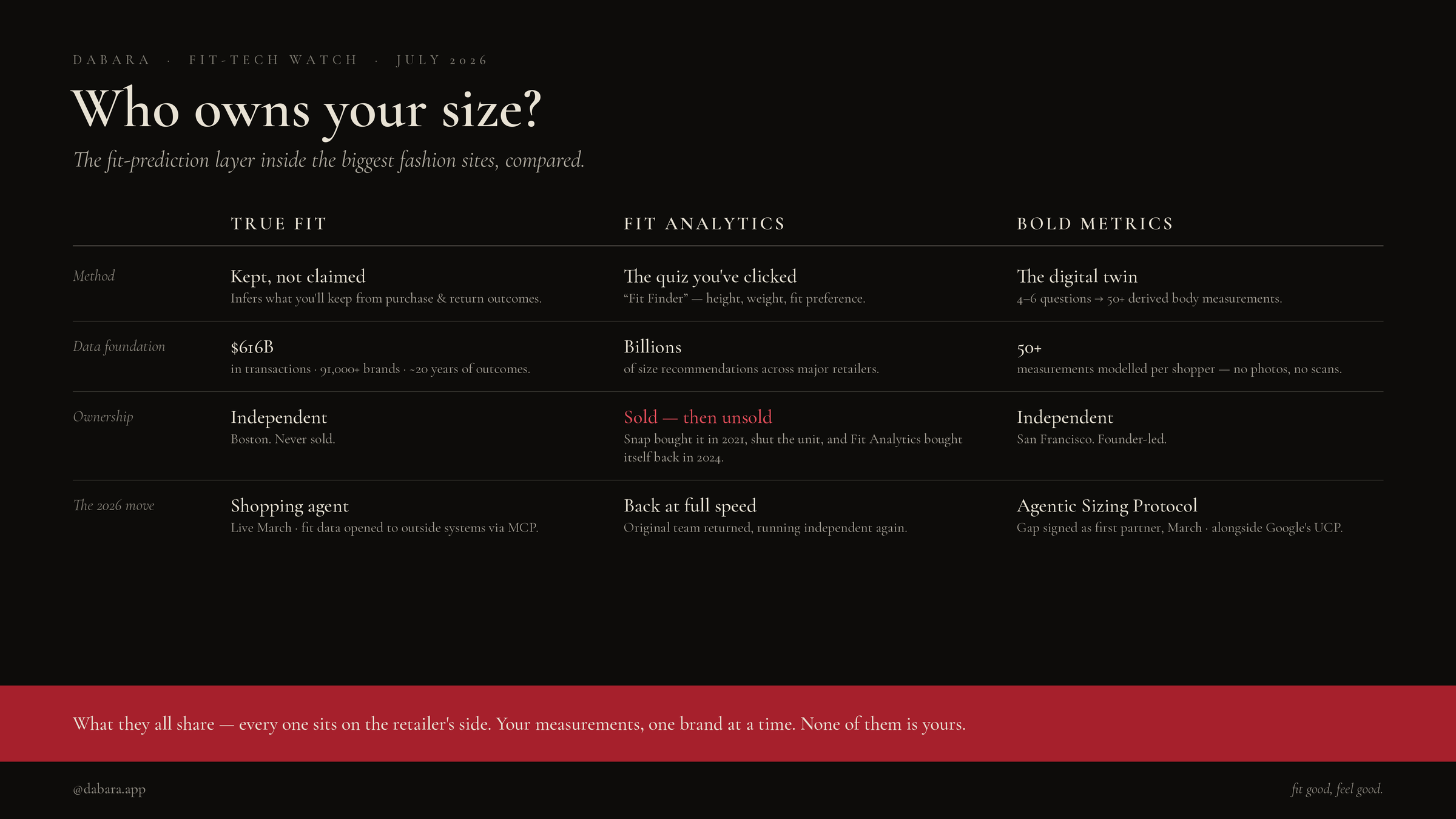
You've almost certainly used fit-prediction technology without ever seeing its name. When ASOS asks a couple of questions and tells you to size up, that's a third-party engine working in the background. Three companies dominate that layer — and in 2026 they're all racing in the same new direction.
True Fit is the largest. It's built on nearly twenty years of purchase-and-return data — 80 million-plus registered shoppers, 91,000-plus brands and over $616 billion in transactions across its retailer network — a dataset it calls the Fashion Genome. The pitch is simple: it doesn't ask what size you think you are, it infers what you'll actually keep, from what people like you kept. In early 2026 it launched a shopping agent that answers "will this fit?" in real time, and it now exposes its fit data to outside systems through the Model Context Protocol.
Fit Analytics built the widget most UK shoppers have actually touched — the "Fit Finder" quiz on large retailers. Its recent history is the quiet story of this category: Snap bought it for $124 million in 2021, folded it into an enterprise AR unit, then shut that unit down — and in 2024 Fit Analytics bought itself back and went independent again. The independents get absorbed, and sometimes spat back out. Either way, the layer holding your measurements changed hands twice, and nobody asked the shoppers.
Bold Metrics took the privacy-friendlier route — no photos, no scans. It asks four to six simple questions and derives more than fifty body measurements from them, building a "digital twin" it claims reduces returns by around 18% on average. It powers brands like Vuori, Canada Goose and Men's Wearhouse, and in 2026 it shipped an Agentic Sizing Protocol built to feed that fit data to shopping agents. The clearest sign of where this is heading: Gap Inc. — Old Navy, Gap, Banana Republic, Athleta — adopted it in March 2026 as an early partner, in the same announcement that made Gap the first major fashion company with native checkout inside Google's Gemini via the separate Universal Commerce Protocol.
Notice what all three share. They sit on the retailer's side of the counter. Their data is your purchase and return history with one brand at a time, fed back by the brand. That's powerful for the retailer — and it's why the whole category's 2026 obsession is becoming the fit layer for automated shopping agents.
But it leaves a gap. None of them is yours. Your measurements live inside each retailer's instance, rebuilt brand by brand, and they vanish the moment you shop somewhere new. The thing a shopper actually wants — one profile of me that makes every item I browse, anywhere, pre-measured to my body — is the one thing a retailer-side tool structurally can't be.
That's the gap worth watching. Fit good, feel good.
https://www.getdabara.com/ → join the waitlist
