Vanity sizing: the number was never anchored
There is a story everybody tells about women's clothing sizes. It goes like this: there used to be a standard, the standard was abandoned in 1983, and ever since then brands have been quietly relabelling larger garments with smaller numbers to flatter the shopper. A 1950s size 12 would be a modern size 4. The number has been sliding for forty years.
Most of that story is repetition. Some of it is wrong. And the part that survives is more interesting than the version in circulation, because it is happening right now rather than in the past.
What the standard actually was
The United States did once publish body measurements for women's clothing. Commercial Standard CS 215-58 arrived in 1958, issued by the National Bureau of Standards and built on an anthropometric study conducted between 1939 and 1941 by O'Brien and Shelton, which measured roughly fifteen thousand women.
It was superseded by PS 42-70, effective 22 December 1970 and published in September 1971. This is the source of a persistent muddle: you will see the successor dated 1970 in some places and 1971 in others. Both are correct. They are different events.
Here is the part almost everyone gets wrong. You will constantly read that the standard was "made voluntary" in 1970, as though it had teeth until then and lost them. It never had teeth. The government catalogue describes CS 215-58 as a recorded voluntary standard of trade, and its successor is titled, in plain words, Voluntary Product Standard. The 1970 change was a rename of the publication series, from Commercial Standard to Voluntary Product Standard. Nothing about its force changed, because there was no force to change.
The standard is then said to have been withdrawn in 1983. That date is repeated everywhere and, as far as I can establish, sourced nowhere. I could find no withdrawal notice behind it. What does exist is a plain statement in the National Institute of Standards and Technology's own records that it is no longer involved in any activities relating to apparel size standards. That is the honest version: not a dramatic abandonment on a specific date, but a slow institutional exit.
From 1995 onward the work sat with ASTM, whose D5585 tables have been revised more than once. Adoption is patchy. There is no body that requires a brand to use them.
The evidence that actually holds
Strip away the decades and ask a narrower question: do women's size labels disagree with each other today, systematically, in a way men's do not?
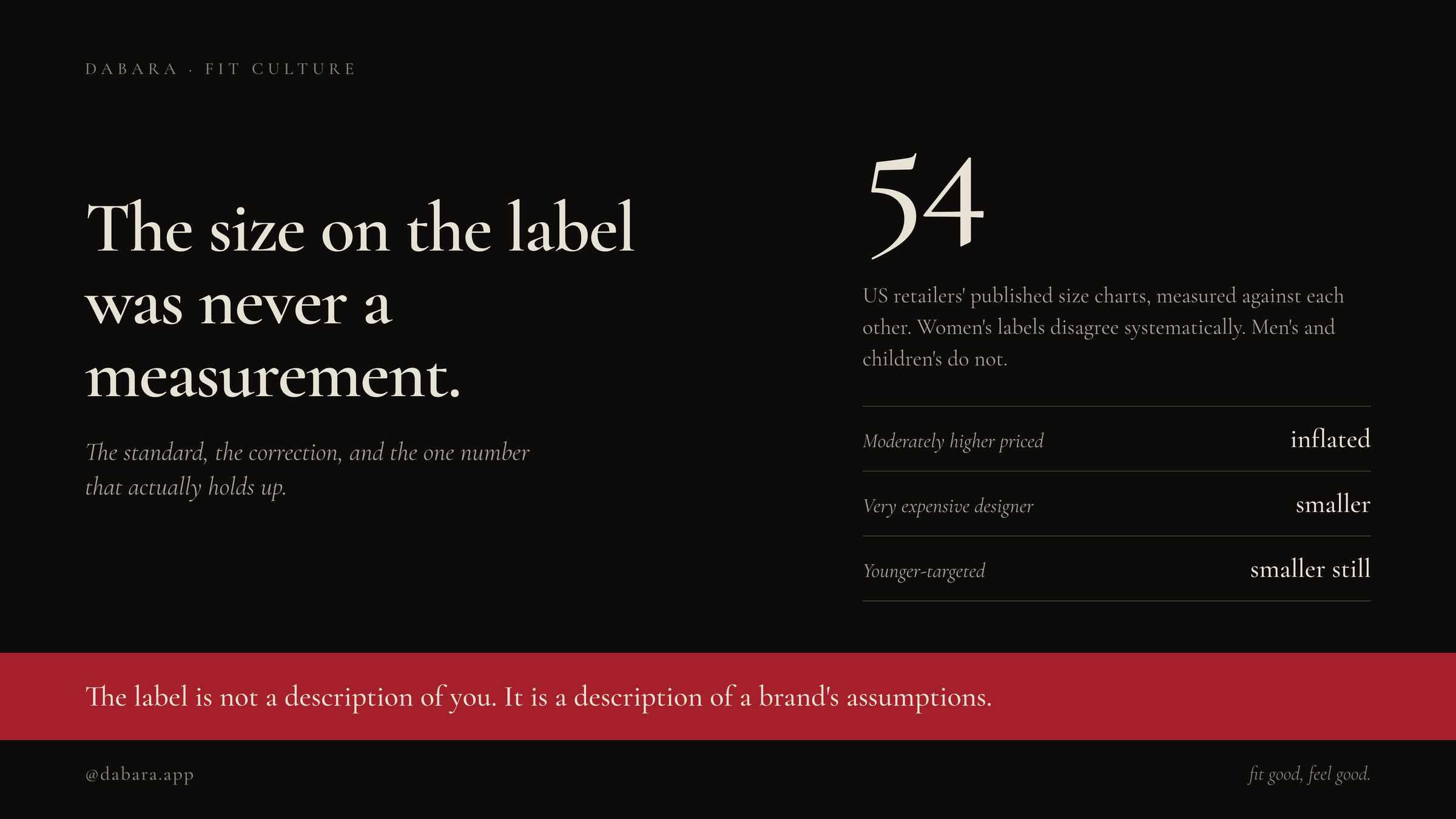
Yes. The strongest work here is by Wan-Ju Iris Franz, published in 2017 in the Journal of Economic Behavior and Organization. She examined the published size charts of 54 American apparel retailers. According to the paper's abstract and highlights, sizes are inflated among women's brands at moderately higher price points, very expensive designer brands measure smaller, and brands aimed at younger women measure smaller than those aimed at older ones. Two labels can both say 8 and mean different bodies, and the direction of the difference tracks what the brand is selling you about yourself.
The paper also reports little to no vanity sizing in men's or children's apparel.
Note what this evidence is and is not. It is a snapshot: 54 brands compared against each other. It is not a study of drift across decades, and it cannot tell you what a 1958 size 12 would be called now. Anyone citing it for that is overreaching. What it establishes is sharper and more useful. The problem is not that the number moved. The problem is that there is no shared referent for it to have moved against.
The men's numbers that look like lying
Men reading this may feel unfairly exempted, and there is a well-known piece of evidence on their side. In 2010 Abram Sauer measured trousers labelled 36 inches across a set of US retailers for Esquire and found actual waistbands from 37 to 41 inches, with Old Navy the widest. CBC's Marketplace later found most men's jeans labelled 38 running an inch or two over.
That looks damning. It mostly is not, and the reason matters.
A men's trouser label states the wearer's intended body waist. It is not a claim about the garment. Because men's trousers are cut to sit on the upper hip rather than the natural waist, the pattern is drawn to a body block and then cut at the hip line, so the finished waistband is necessarily larger than the number on the label. That gap is ease. It is design, disclosed in the convention itself, and it is why our own denim measurements found Levi's and ASOS labelling a 32 within millimetres of each other at 81.3cm and 81cm.
One caveat, because the neat version of this argument does not survive the whole dataset. A five-inch gap on a 36 exceeds any plausible allowance for rise. Ease explains most of the spread Sauer found. It does not explain all of it, and the widest example is not fully accounted for by the convention.
The strongest objection
The most serious counter-argument is that this entire genre rests on a category error. The sewing industry writer behind Fashion-Incubator has argued for years that garment size numbers were always ordinal, a position on a scale rather than a measurement in inches, and that a number changing meaning over time is evolution rather than deception.
For the historical claim, that is largely right, and it is the reason the vintage comparison charts should be treated with suspicion.
It does not touch the present-tense finding. Franz compares brands against each other in the same year. No historical baseline is required, and no assumption about what a number used to mean is doing any work.
What this means if you are trying to get dressed
If you are a man, your waist label is close to honest, and the fit problems you actually have are not there. They are at the chest, the shoulder and the thigh, where no number appears on the label at all.
If you are a woman, the number on the label is not a measurement and was never quite one. It is a brand's positioning statement, and it will disagree with the next brand's positioning statement by a predictable amount and in a predictable direction.
Either way the conclusion is the same. The size label is not a description of you. It is a description of a brand's assumptions, and the only way to shop across brands with any confidence is to work from measurements the brand publishes rather than the number it prints.
That is the problem Dabara exists to solve.
Sources: Franz, Wan-Ju Iris (2017), "Economics of vanity sizing", Journal of Economic Behavior and Organization, vol. 134, pp. 336-355 (abstract and highlights; full text paywalled). US Commercial Standard CS 215-58 and Voluntary Product Standard PS 42-70, National Bureau of Standards, via NIST and US government catalogue records. ASTM D5585. Abram Sauer, Esquire, 2010. CBC Marketplace. Fashion-Incubator, "The myth of vanity sizing". Dabara denim measurements, July 2026.
