
Six Fits, No Numbers
We read the published size guides of Nike, adidas and Under Armour. Sportswear is supposed to be the category that got sizing right. It has the widest medium we have measured, and the word that actually decides the fit has no number behind it.
Sportswear should be the one that gets this right.
It is the category built on measurement. It sells to people who count their reps and weigh their food and know their own numbers better than any other kind of shopper alive. If any corner of clothing had solved the problem of telling you what will fit, you would expect it to be this one.
So we read the size guides. Nike, adidas, Under Armour, the three brands hanging on the same rail in every sports shop in the country. We lined up the chest measurement behind the letter, the way we did with the high street back in July.
The high street, you may remember, came out better than expected. Seven UK brands broadly agreed on where a men's medium sits, somewhere around 96 to 102 centimetres, and the problem was the width of the letter: six or seven centimetres of different men all handed the same shirt.
Sportswear is wider.
Three and a half inches inside one letter
A Nike medium is built for a chest of 37.5 to 41 inches, which is roughly 95 to 104 centimetres. That is a span of three and a half inches, just under nine, wider than any high-street brand we measured. A man at the bottom of that band and a man at the top walk out with the same garment, and both of them are, officially, correct.
adidas runs a medium at 93 to 100 centimetres. Under Armour's UK guide runs it at 38 to 40 inches.
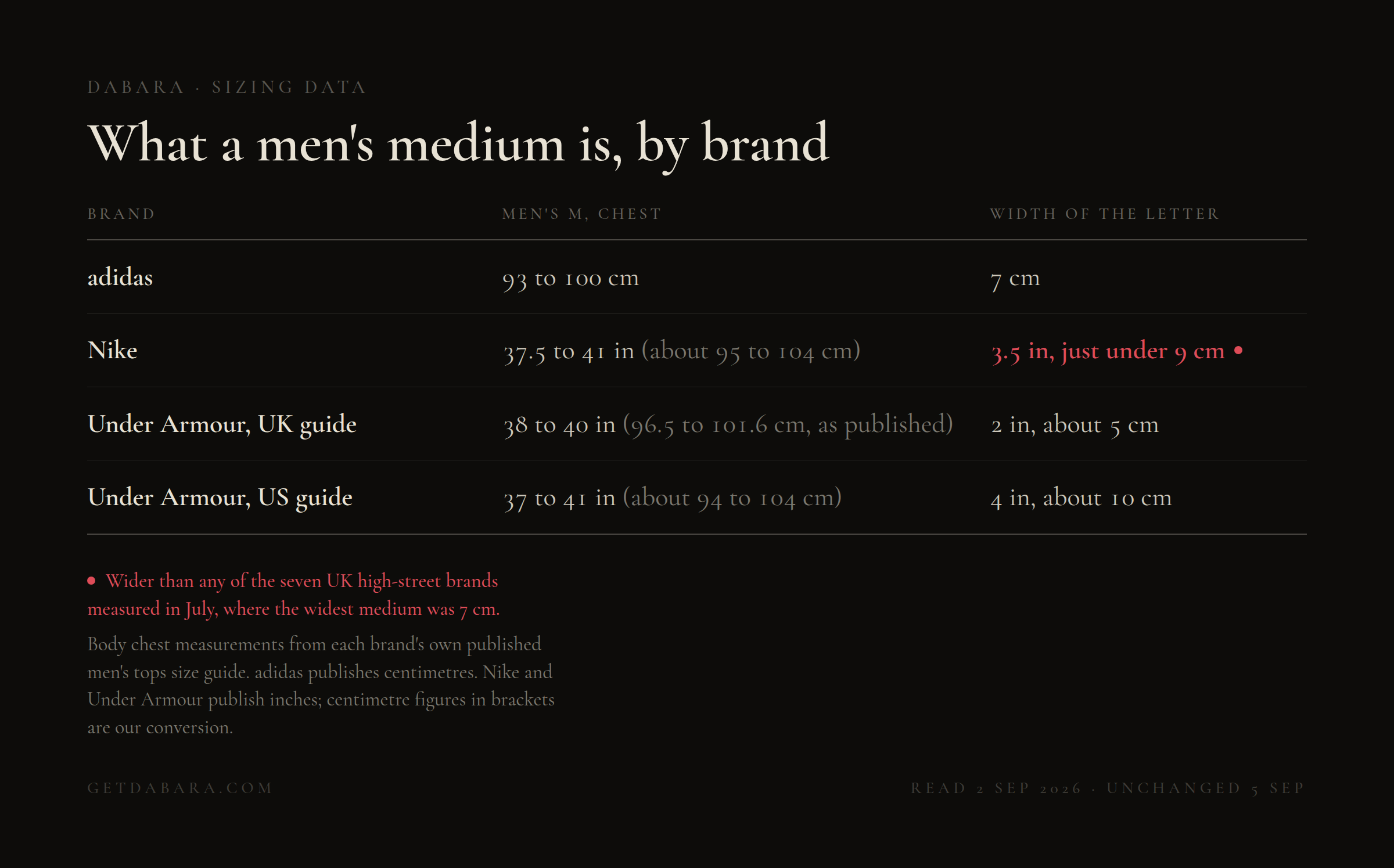
Line those up and something awkward falls out. A 101 centimetre chest is a Nike medium and an adidas large. Not a matter of taste or preference. Two published charts, one body, a whole size apart.
The chest with no size
Then there is the 94 centimetre chest.
At adidas it is a comfortable medium. At Nike it is a small. At Under Armour, in the UK, it is nothing at all.
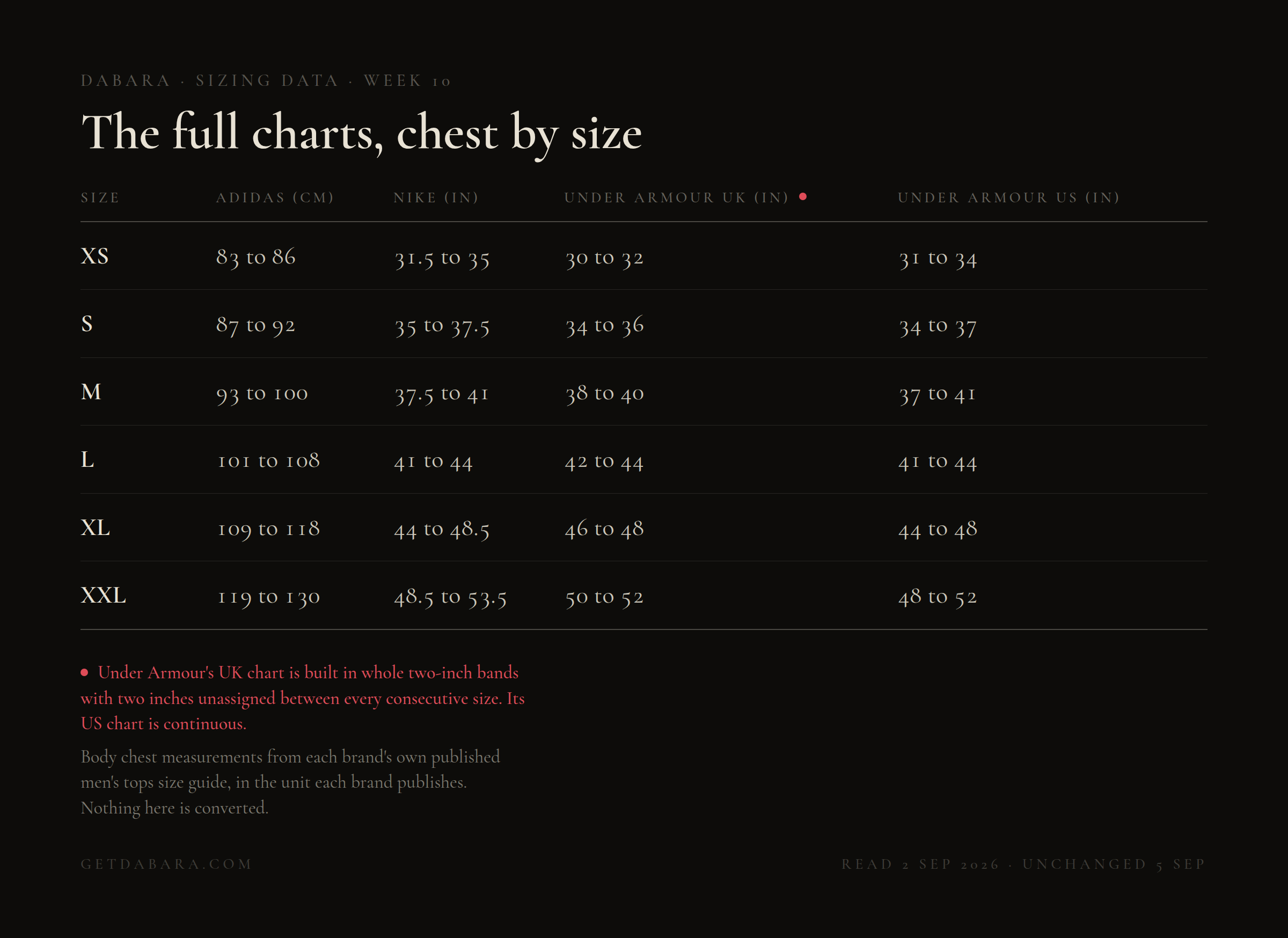
Under Armour's UK chart runs a small at 34 to 36 inches and a medium at 38 to 40. The two inches in between belong to no size. And it is not a one-off: the same gap sits between every consecutive size on that chart, all the way up. If your chest lands in one of them, the guide has no answer for you, and the honest thing it could say is that it does not know.
It is worth being precise about what this is. Nobody is hiding anything. The chart is right there, published, free to read. It is a chart built in whole inches and then left with the spaces between the inches unfilled, which is the sort of thing that happens when a size guide is treated as a rough steer rather than a promise.
Under Armour's American chart, for what it is worth, has no gaps at all. It runs continuously, and it puts a medium at 37 to 41 inches. Same brand, same garments, two countries, two different answers to what a medium is.
The second sizing system
All of which would be a story about charts, if the chart were the thing that decided how clothes fit. It isn't.
Look at what happens after the letter. Under Armour sells its tops in six named fits: Compression, Tight, Fitted, Regular, Relaxed and Oversized. Each one gets a sentence. Compression is "ultra-tight, second-skin fit". Relaxed is a "generous, loose fit with plenty of room to move". Nike names the fit in the product title, so a Nike Pro long-sleeve arrives as a slim fit, "sleek and tailored", and a near-identical short-sleeve arrives as a tight fit. adidas runs a Techfit compression line.
Now go looking for a number behind any of those words. There isn't one.
Not on the product page, which publishes no garment measurements. Not on the size guide, which is the page whose entire job is to explain sizing and which does not define fit types, at either adidas or Nike. The two systems never appear on the same screen. One of them has measurements and does not determine how the garment sits on you. The other determines how the garment sits on you and has adjectives.
So a man with a 100cm chest reads the chart, correctly identifies himself as a medium at all three brands, and then buys a medium that could be a second skin or could be deliberately enormous, depending entirely on which word was in the product title and what he thought that word meant.
What "compression" is worth
There is a useful comparison sitting one aisle over.
Compression is also a medical category. Compression hosiery in the UK is graded by the pressure it applies at the ankle, in millimetres of mercury, under a British Standard, in three classes: roughly 14 to 17, 18 to 24, and 25 to 35. If you want to know what a class 2 stocking does, there is a number, a range, and a test that produces it.
A compression training top is graded by a sentence written to sell it.
That is not an accusation. There is no reason a gym top should be a medical device, and nobody has claimed otherwise. It is just a clean illustration of how much work a single word can be asked to do when nothing is standing behind it. In one context the word is a measurement. In the other it is a mood.
Why we built Dabara
None of this is the shopper's problem to solve, and yet it lands on him anyway.
You cannot be expected to know that your chest falls in a gap in one brand's chart, or that the same number makes you a medium at one brand and a large at the next, or that the word "slim" is doing more to determine your fit than the letter you spent a minute looking up.
So we ask you once. You tell Dabara about your body a single time, and every piece you look at arrives already measured against you. Not against a letter, not against an average, not against an adjective. What is left is the only question that was ever worth asking: does this fit?
Fit good, feel good. Join the waitlist.
The numbers
Every figure above comes from the brand's own published men's tops size guide, read on 2 September 2026 and read again, unchanged, on 5 September. adidas publishes centimetres. Nike's UK guide publishes inches only, so any centimetre figure attributed to Nike is our conversion and is marked "about". Under Armour's UK guide publishes inches with a centimetre toggle that gives the exact conversion, 96.5 to 101.6 cm for a medium, and we use its figures as published. The full charts, chest measurement by size:
Fit descriptions are quoted from Under Armour's UK size guide and from Nike's product pages for the Nike Pro long-sleeve and short-sleeve fitness tops. The compression hosiery classes are as set out in NHS prescribing guidance citing British Standard BS 6612; we have not read the standard itself.
This piece describes what three brands publish, with dates. Under Armour naming and defining six fits is more than most of the high street offers, and none of the three is doing anything the others are not. The point is what the system leaves out, not who left it out.
